Introduction
Selecting the correct grade of stainless steel bright bars is not just a material choice — it directly affects performance, durability, machining efficiency, and long-term operating cost. In many industrial applications, failures such as corrosion, cracking, excessive tool wear, or premature replacement occur not because of poor manufacturing, but because the wrong stainless steel grade was chosen.
Each stainless steel series is designed for a specific purpose. Some grades offer higher corrosion resistance, some provide greater mechanical strength, others improve machinability, and certain grades help control overall material cost. Choosing the right balance depends on where and how the component will be used.
This guide helps engineers, fabricators, procurement teams, and manufacturers select the right stainless steel bright bars grade based on application requirements, service environment, and expected performance.
What Are Stainless Steel Bright Bars?
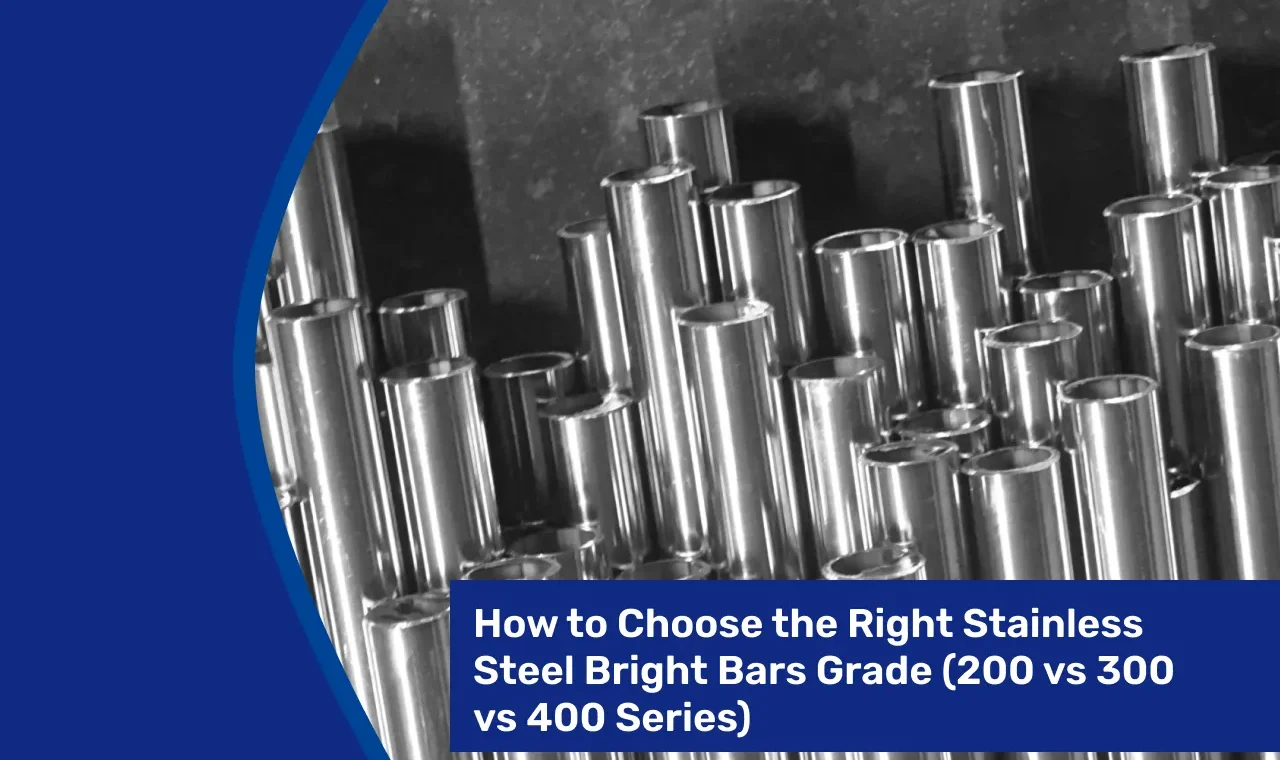
Stainless steel bright bars are precision-finished bars manufactured with tight tolerances, smooth surface finish, and improved mechanical properties compared to hot-rolled material. They are widely used in machining applications where accurate dimensions and surface quality are important.
Manufacturing Process
Bright bars are produced through secondary finishing operations:
- Cold Drawn – increases strength and dimensional accuracy
- Peeled & Polished – removes surface imperfections
- Centerless Ground – provides highest tolerance and smoothness
Key Characteristics
- Excellent dimensional accuracy
- Smooth surface finish
- Good machinability
- Higher strength than hot-rolled bars
Typical Applications
Used in shafts, fasteners, fittings, valves, machine parts, and automotive components where precision and durability are required.
Stainless Steel Series Classification
Stainless steels are classified based on their metallurgical structure, and this structure directly determines corrosion resistance, strength, machinability, and suitability for different applications. Understanding these categories helps in selecting the correct stainless steel bright bars grade for a specific operating environment.
Similar metallurgical classifications are also followed in stainless steel wire products, where grade selection determines corrosion resistance and mechanical performance.
Austenitic Stainless Steel (200 & 300 Series)
Austenitic grades are the most commonly used stainless steels because of their corrosion resistance and formability. They are generally non-magnetic and perform well in moisture, chemical, and hygienic conditions.
Key characteristics:
- Non-magnetic structure
- Excellent corrosion resistance
- Good formability and weldability
- Suitable for chemical, food, and sanitary environments
Martensitic & Ferritic Stainless Steel (400 Series)
The 400 series offers higher strength and wear resistance compared to austenitic grades. These steels are magnetic and can be heat treated, making them suitable for engineering and load-bearing components.
Key characteristics:
- Magnetic structure
- Heat treatable hardness
- High strength and wear resistance
- Suitable for mechanical and structural applications
Understanding this classification is the first step in choosing the correct stainless steel bright bars grade for performance, durability, and cost efficiency.
200 vs 300 vs 400 Series Stainless Steel Bright Bars — Comparison
The table compares 200, 300, and 400 series stainless steel bright bars based on corrosion resistance, strength, machinability, and cost. It helps identify which grade is most suitable depending on application environment and performance requirements.
Property | 200 Series | 300 Series | 400 Series |
Corrosion Resistance | Moderate | Excellent | Low to Moderate |
Strength | Medium | Medium | High |
Machinability | Good | Moderate | Excellent |
Cost | Low | High | Medium |
Magnetic Property | Non-magnetic | Non-magnetic | Magnetic |
Typical Applications | General fabrication & structures | Food, chemical & marine environments | Shafts, fasteners & engineering parts |
When to Choose 200 Series Stainless Steel Bright Bars
The 200 series stainless steel bright bars are suitable for applications where cost efficiency is important and the operating environment has limited corrosion exposure. These grades provide a practical balance between performance and affordability, making them a common choice for general fabrication and light industrial use.
Recommended Applications
- Indoor fabrication work
- Furniture manufacturing
- Decorative and architectural structures
- Light engineering components
Typical Grades: 202, 204Cu
Overall, the 200 series is preferred when moderate strength and acceptable corrosion resistance are sufficient, helping reduce material cost without compromising basic performance.
When to Choose 300 Series Stainless Steel Bright Bars
The 300 series stainless steel bright bars are known for their excellent corrosion resistance and are commonly used in hygienic or aggressive environments.
AISI 304 stainless steel is generally selected for bright bar components requiring reliable corrosion resistance in standard atmospheric and food-grade environments. 316 stainless steel is preferred where exposure to chlorides, moisture, or chemicals increases the risk of pitting corrosion and material degradation.
These grades perform reliably in moisture, chemicals, and temperature variations, making them suitable for applications where durability and cleanliness are essential.
Recommended Applications
- Food processing equipment
- Pharmaceutical machinery
- Marine components
- Chemical handling systems
Typical Grades: 304, 304L, 316, 316L
When corrosion resistance and long service life are critical requirements, the 300 series is generally the safest and most dependable choice.
When to Choose 400 Series Stainless Steel Bright Bars
The 400 series stainless steel bright bars are selected for applications requiring high strength and wear resistance. These grades are heat treatable and perform well in load-bearing and mechanical components where durability is more important than corrosion resistance.
Recommended Applications
- Shafts
- Pumps and valves
- Fasteners
- Automotive components
- Engineering machinery
Typical Grades: 410, 420, 430
This series is ideal for mechanical and structural parts exposed to stress, friction, and repeated movement rather than corrosive environments.
Application-Based Grade Selection Guide
Application | Recommended Stainless Steel Bright Bar Grade |
CNC Machining Components | 303 / 410 |
Marine Environment | 316 |
Food Processing Equipment | 304 / 316 |
Structural Fabrication | 202 / 304 |
Automotive Shafts | 410 / 420 |
Fabricated structures using bright bars may also require compatible stainless steel welding wires to ensure consistent mechanical strength and corrosion performance.
Cost vs Performance Consideration
A common mistake during material selection is choosing stainless steel bright bars only based on price or only based on performance. Both approaches can increase overall operating cost instead of reducing it.
Selecting a higher grade than required leads to unnecessary expense, while selecting a lower grade than needed can cause corrosion, wear, or premature component failure. The correct approach is to match material properties with the actual operating environment and load conditions.
Key Points to Consider
- Over-specifying → increases material cost without real performance benefit
- Under-specifying → leads to early failure and replacement expense
- Proper selection → balances durability, performance, and budget
Choosing the right grade based on application requirements ensures long service life and cost efficiency.
Common Mistakes in Stainless Steel Bright Bar Selection
Incorrect material selection often leads to premature wear, corrosion problems, or higher maintenance costs. Many issues occur not because the material is defective, but because the grade does not match the application requirements.
- Choosing Only Based on Price: Selecting the lowest-cost grade may reduce initial expense but often leads to early failure. Total lifecycle cost becomes higher due to replacement and downtime.
- Ignoring Corrosion Environment: Different environments require different corrosion resistance levels. Using the wrong grade can cause rusting, pitting, or material degradation.
- Overlooking Machinability Needs: Some grades are harder to machine and increase tool wear and production time. Proper selection improves machining efficiency and finish quality.
- Not Verifying Dimensional Tolerances: Precision components require accurate sizing and straightness. Incorrect tolerance capability can affect assembly and performance.
- Using Corrosion Grade Instead of Strength Grade: High corrosion resistance does not always mean high strength. Mechanical applications often need stronger martensitic grades instead.
Avoiding these mistakes improves component reliability, increases service life, and reduces long-term maintenance cost.
Quick Selection Decision Chart
Choosing the correct stainless steel bright bars grade can be simplified by evaluating the operating environment, mechanical load, and cost requirements. This step-based approach helps engineers and buyers quickly narrow down the most suitable series before final specification.
Selection Steps
- Step 1: Check corrosion exposure
If the component operates in moisture, chemicals, or marine conditions, select the 300 series for higher corrosion resistance. - Step 2: Evaluate strength requirement
If the application involves load-bearing parts, wear, or friction, choose the 400 series for better hardness and durability. - Step 3: Consider budget with mild exposure
For general indoor or low-corrosion environments, the 200 series provides a cost-effective solution.
This practical method covers most industrial applications and helps balance performance with material cost.
Choosing a Reliable Stainless Steel Bright Bars Supplier
The performance of stainless steel bright bars depends not only on the grade but also on manufacturing control and inspection quality. Even the correct material specification can fail if dimensional accuracy, heat treatment, or surface finish is inconsistent.
To ensure reliable performance and long service life, buyers should evaluate the supplier’s production capability and quality assurance practices before procurement. Manufacturers such as Ratanakar Wire Private Limited focus on controlled processing and inspection standards to maintain consistent product quality across applications.
Key Factors to Verify
- Mill test certificates – confirm chemical composition and mechanical properties
- Dimensional tolerance capability – ensures proper fit in precision assemblies
- Surface finish consistency – important for machining and wear performance
- Heat treatment control – maintains strength and hardness uniformity
- Custom size availability – supports specific engineering requirements
A reliable supplier provides consistent quality across batches, reducing rejection rates, downtime, and long-term maintenance cost.
Conclusion
Selecting the correct stainless steel bright bars grade directly affects durability, machining efficiency, maintenance cost, and operational safety. The choice should always be based on application requirements rather than material availability.
The 200 series is suitable for economical fabrication and general-purpose use, the 300 series performs best in corrosion-resistant environments, and the 400 series is preferred for strength-based engineering applications where load and wear resistance are critical.
Matching the grade to the service environment ensures longer component life and optimized overall cost. For critical or high-performance applications, you can always contact us for your specific requirement to ensure the right material selection and reliable performance.
FAQS
1. What is the difference between 200, 300, and 400 series stainless steel bright bars?
The 200 series is cost-effective for general fabrication, the 300 series offers high corrosion resistance, and the 400 series provides higher strength and wear resistance for mechanical parts.
2. Which stainless steel bright bar grade is best for corrosive environments?
The 300 series, especially grades like 304 and 316, is best for corrosive, marine, and chemical environments due to superior corrosion resistance.
3. When should 400 series stainless steel bright bars be used?
400 series grades are ideal for shafts, fasteners, valves, and automotive components where strength and hardness are more important than corrosion resistance.
4. Are stainless steel bright bars suitable for machining applications?
Yes, stainless steel bright bars are widely used in machining because of their dimensional accuracy, smooth surface finish, and consistent mechanical properties.
5. How do I choose the right stainless steel bright bar grade?
Select the grade based on environment, load requirement, corrosion exposure, and budget. Matching these factors ensures performance reliability and cost efficiency.