Introduction
Stainless steel wires play a vital role across industrial, commercial, and manufacturing sectors due to their high strength, corrosion resistance, durability, and long service life. From fabrication and welding to wiring and mechanical applications, stainless steel wire products are trusted for consistent performance in demanding environments.
However, stainless steel wires are not limited to a single form or use. They are manufactured in different types and configurations such as wire rods, wire spools, wiring wires, wire ropes, spring wires, and welding wires each engineered to meet specific functional and operational requirements.
This guide explores the different types of stainless steel wires and their uses, helping buyers, engineers, and manufacturers select the right stainless steel wire type based on application needs, performance expectations, and industry standards.
What Are Stainless Steel Wires?
Stainless steel wires are precision-drawn metallic products made from high-quality stainless steel alloys, primarily containing chromium, nickel, and other elements. These wires combine excellent corrosion resistance, wear resistance, and chemical stability with superior mechanical strength and flexibility, making them ideal for industrial, commercial, and mechanical applications.
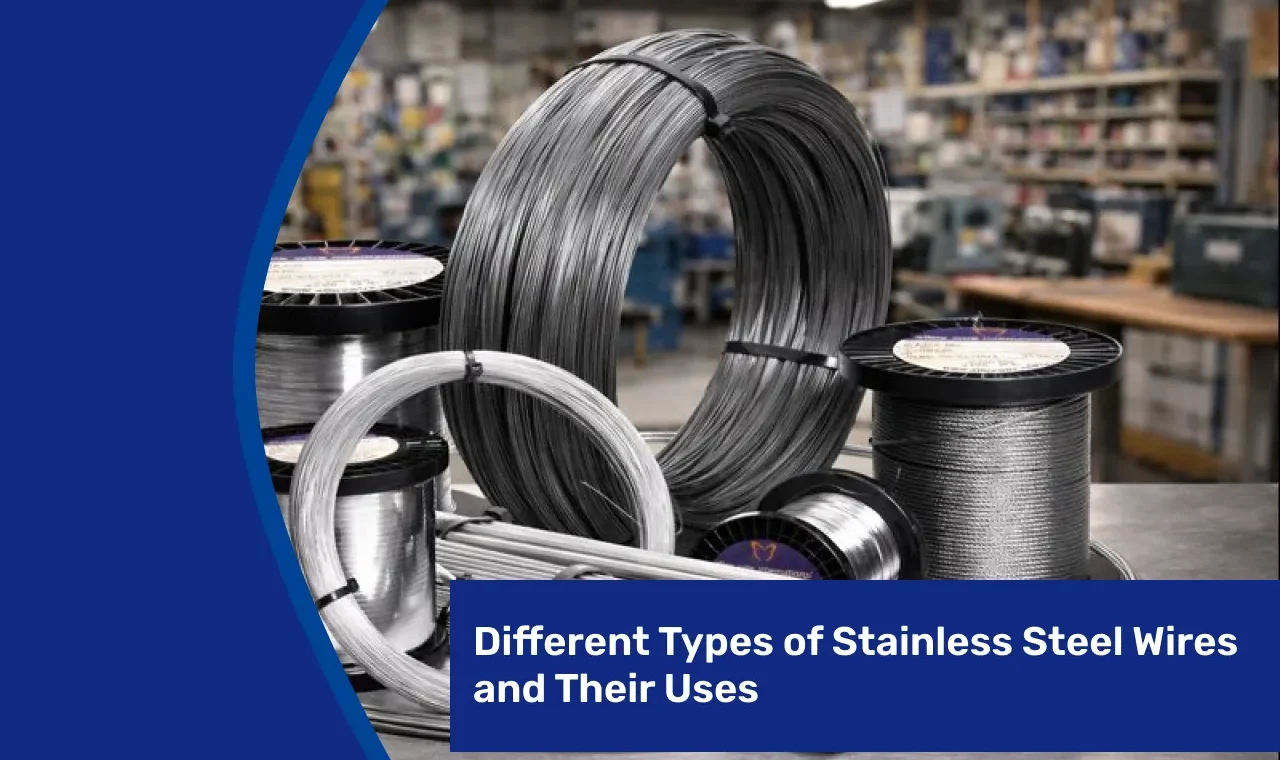
Stainless steel wires are manufactured in a variety of types and forms to suit specific uses. Common forms include wire spools, Filter wires, wire ropes, spring wires, and welding wires, Mig wires each engineered to meet distinct operational requirements while ensuring long-term reliability and performance.
Common Types of Stainless Steel Wires
Stainless Steel Wire Spool
Stainless steel wire spools consist of wire wound onto spools for easy handling, storage, and controlled dispensing.
Key Characteristics:
- Precise winding for continuous feeding
- Reduced tangling and wastage
- Available in multiple diameters and finishes
Uses:
Commonly used in welding machines, industrial wiring, automated production lines, and fabrication units.
Stainless Steel Wire Rope
Stainless steel wire rope is made by twisting multiple stainless steel wire strands together to create a high-strength cable.
Key Characteristics:
- High load-bearing capacity
- Excellent resistance to corrosion
- Long operational life
Uses:
Widely used in lifting equipment, marine applications, architectural structures, and safety systems.
Stainless Steel Spring Wire
Stainless steel spring wire is manufactured to provide high elasticity and fatigue resistance.
Key Characteristics:
- High tensile strength
- Excellent resilience under stress
- Uniform mechanical properties
Uses:
Used in springs, clips, fasteners, and mechanical components where repeated motion or load is involved.
Stainless Steel Welding Wire
Stainless steel welding wire is designed to produce strong and clean weld joints in fabrication processes.
Key Characteristics:
- Smooth arc performance
- Strong weld penetration
- Corrosion-resistant weld joints
Uses:
Used in TIG and MIG welding for stainless steel fabrication and structural assemblies.
Stainless Steel MIG Wire
Stainless steel MIG wire is a continuous electrode wire used in MIG welding processes.
Key Characteristics:
- Consistent wire feed
- High welding efficiency
- Suitable for automation
Uses:
Used extensively in industrial welding, manufacturing plants, and fabrication workshops.
Stainless Steel Filler Wire
Stainless steel filler wire is used to fill and strengthen joints during welding operations.
Key Characteristics:
- Compatible with base metals
- Enhances joint strength
- Improves weld durability
Uses:
Commonly used in repair work, fabrication, and stainless steel joining applications.
Benefits of Using the Right Stainless Steel Wire Type
Choosing the correct type of stainless steel wire offers multiple advantages for industries and manufacturers:
- Improved Operational Efficiency: Using the appropriate wire type ensures smooth production, precise applications, and reduced downtime.
- Reduced Material Waste: Selecting the right wire minimizes errors, scrap, and rework, saving both time and resources.
- Enhanced Durability and Safety: Proper wire types provide superior corrosion resistance, strength, and reliability, enhancing product lifespan and workplace safety.
- Better Cost Control and Performance: Optimized wire selection reduces maintenance costs while improving overall performance and efficiency.
By selecting the right stainless steel wire type for your specific application, manufacturers and engineers can achieve long-term reliability, superior performance, and optimal results in every project.
Why Choose Ratanakar for Stainless Steel Wires
Ratanakar is a trusted manufacturer and supplier of premium stainless steel wires, delivering a wide range of wire types tailored to meet the diverse needs of industrial, commercial, and manufacturing sectors.
Key Advantages of Ratanakar Stainless Steel Wires:
- Comprehensive Product Range: From wire ropes and spools to spring, welding, and alloy wires, Ratanakar offers solutions for every application.
- Precision Manufacturing & Quality Control: Modern infrastructure and strict quality standards ensure uniformity, strength, and performance.
- Custom Diameters, Finishes & Packaging: Wires are available in various sizes, surface finishes, and packaging options, including bulk and export-ready supplies.
- Reliable Bulk Supply: Consistent production and timely delivery make Ratanakar a dependable partner for large-scale industrial projects.
Choosing Ratanakar Stainless Steel Wires guarantees high-quality, durable, and application-ready wire products, ensuring operational efficiency and long-term reliability for your business.
Conclusion
Stainless steel wires come in a variety of types and forms, each engineered to meet specific industrial, commercial, and mechanical requirements. Understanding the different types of stainless steel wires and their applications ensures optimal performance, enhanced durability, and cost efficiency for every project.
Partnering with an experienced and trusted manufacturer like Ratanakar guarantees access to the right wire type, consistent high-quality products, and reliable long-term supply, helping businesses achieve efficient, safe, and durable solutions for all their stainless steel wire needs. For technical guidance, bulk inquiries, or customized specifications, contact us for stainless steel wires and our team will assist you with the right solution for your application.
FAQs
1. What are the different types of stainless steel wires?
Different types of stainless steel wires include wire rod, wire spool, wiring wire, wire rope, spring wire, welding wire, MIG wire, filler wire, and stainless steel alloy wire.
2. What is a stainless steel wire spool used for?
Stainless steel wire spools are used for controlled wire feeding in welding, industrial wiring, and automated manufacturing processes, offering easy handling and reduced material waste.
3. Is steel wire for wiring different from welding wire?
Yes, steel wire for wiring is designed for flexibility and support, while welding wire is used to create strong joints during TIG or MIG welding processes.
4. What is stainless steel alloy wire used for?
Stainless steel alloy wire is used in high-performance applications requiring enhanced strength, corrosion resistance, or heat resistance beyond standard stainless steel wires.
5. Does Ratanakar supply all types of stainless steel wires?
Yes, Ratanakar supplies a wide range of stainless steel wire types with customizable sizes, finishes, and packaging options for industrial and export requirements.