Introduction
Steel wire is a widely used material in industries such as manufacturing, construction, automotive, marine, and engineering due to its strength and versatility. The two most commonly used types are stainless steel wire and carbon steel wire.
The main difference between them is corrosion resistance and strength balance. Stainless steel wire offers excellent resistance to rust and chemicals, while carbon steel wire provides higher strength at a lower cost but is more prone to corrosion.
Choosing the right wire is important because it directly affects product durability, safety, maintenance requirements, and long-term cost efficiency.
This guide explains the key differences between stainless steel wire and carbon steel wire, their properties, applications, and how to choose the right one for specific industrial needs.
What is Stainless Steel Wire?
Stainless steel wire is a corrosion-resistant metal wire made from an iron-based alloy containing at least 10.5% chromium. This chromium forms a thin, protective oxide layer on the surface that prevents rust, corrosion, and environmental damage.
Because of this property, stainless steel wire is widely used in applications where strength, durability, and resistance to moisture, chemicals, or heat are required.
To understand how different grades affect performance and applications, you can explore more about Popular Grades of Stainless Steel Wire, which explains how each grade is selected based on industrial needs.
Key Properties of Stainless Steel Wire
- High corrosion and rust resistance due to the chromium oxide layer
- Long service life with minimal maintenance
- Good heat and chemical resistance for industrial environments
- Smooth and clean surface finish suitable for aesthetic applications
- Strong and durable performance in harsh or humid conditions
Common Grades of Stainless Steel Wire
- 304 / 304L – General-purpose grade used in food processing, construction, and industrial applications
- 316 / 316L – Higher corrosion resistance, ideal for marine, coastal, and chemical environments
- 308 / 308L – Commonly used in welding applications and filler materials
For a deeper understanding of how these grades are selected and their industrial usage, refer to Popular Grades of Stainless Steel Wire.
Stainless steel wire is preferred in industries where corrosion resistance, hygiene, and long-term durability are more important than cost. It is commonly used in marine structures, food processing equipment, medical instruments, construction, and chemical plants.
What is Carbon Steel Wire?
Carbon steel wire is a strong metal wire made primarily from iron and carbon, with very few alloying elements. The increased carbon content improves its strength, hardness, and load-bearing capacity, but reduces its resistance to corrosion and rust.
Because of this combination, carbon steel wire is widely used in applications where high strength is required and exposure to moisture or corrosive environments is limited.
Key Properties of Carbon Steel Wire
- High tensile strength and hardness for heavy-duty applications
- Excellent load-bearing capacity under mechanical stress
- Low corrosion resistance, prone to rust without a protective coating
- Cost-effective material compared to stainless steel wire
- Easy to fabricate, process, and manufacture at scale
Common Types of Carbon Steel Wire
- High carbon steel wire – Maximum strength and hardness, used in springs and high-stress applications
- Medium carbon steel wire – Balanced strength and flexibility for general engineering use
- Low-carbon steel wire (mild steel wire) – More ductile and easier to shape, used in construction and binding
Carbon steel wire is preferred in industries where strength, affordability, and performance under load are more important than corrosion resistance. It is commonly used in construction, automotive components, wire ropes, fencing, and general manufacturing applications.
Key Differences Between Stainless Steel Wire and Carbon Steel Wire
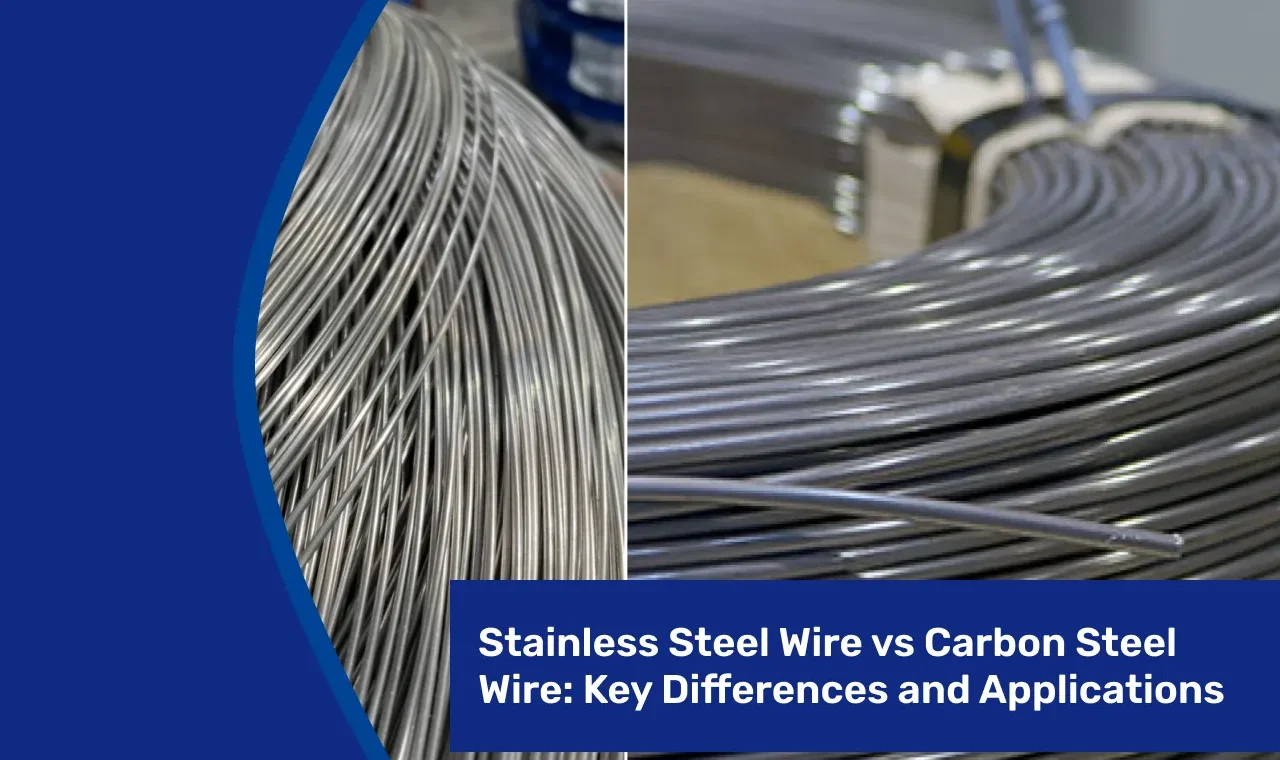
Stainless steel wire and carbon steel wire differ significantly in terms of corrosion resistance, strength behavior, durability, cost, and application suitability.
Understanding these differences helps in selecting the right material for specific industrial and environmental conditions.
4.1 Corrosion Resistance
- Stainless steel wire offers excellent corrosion and rust resistance due to its chromium oxide protective layer.
- Carbon steel wire: Easily corrodes when exposed to moisture, air, or chemicals unless coated or treated.
4.2 Strength and Hardness
- Stainless steel wire provides balanced strength with good flexibility and long-term structural stability.
- Carbon steel wire offers higher tensile strength and hardness, making it suitable for heavy-load applications.
4.3 Durability and Lifespan
- Stainless steel wire: Highly durable with a long service life, especially in harsh or corrosive environments.
- Carbon steel wire: Less durable in exposed conditions and may degrade faster without protective coatings.
4.4 Cost and Affordability
- Stainless steel wire: More expensive due to alloy composition and corrosion-resistant properties.
- Carbon steel wire: More economical and widely used in cost-sensitive applications.
4.5 Weldability and Machinability
- Stainless steel wire: Weldable but requires controlled techniques to avoid heat distortion and corrosion issues.
- Carbon steel wire: Easier to weld, cut, and machine, making it more fabrication-friendly.
4.6 Appearance and Finish
- Stainless steel wire: Smooth, shiny, and aesthetically clean finish suitable for visible applications.
- Carbon steel wire: Dull finish that may darken or discolor over time if not coated.
Applications of Stainless Steel Wire
Stainless steel wire is widely used across industries where corrosion resistance, hygiene, strength, and long-term durability are critical. Its ability to withstand moisture, chemicals, and extreme environments makes it ideal for demanding applications.
Key Applications of Stainless Steel Wire
- Marine and Offshore Industry: Used in ships, docks, and offshore structures where constant exposure to saltwater can cause rapid corrosion in other metals. Stainless steel wire ensures long-lasting performance in harsh marine environments.
- Food Processing and Packaging: Applied in food production equipment, conveyor systems, and packaging machinery due to its hygienic, non-corrosive, and easy-to-clean properties.
- Chemical and Petrochemical Industry: Used in pipelines, filters, and structural supports where exposure to acids, chemicals, and high temperatures requires strong corrosion resistance.
- Medical and Surgical Applications: Used in surgical tools, dental instruments, and medical devices because it is hygienic, non-reactive, and resistant to sterilization processes.
- Architectural and Construction Applications: Commonly used in railings, wire mesh, safety cables, and façade systems where both strength and visual appearance are important.
- Aerospace and Precision Engineering: Used in aircraft components, control systems, and precision instruments where high strength-to-weight ratio and reliability are essential.
Stainless steel wire is preferred in critical applications because it offers excellent resistance to rust, chemicals, and environmental wear, ensuring long service life with minimal maintenance.
Applications of Carbon Steel Wire
Carbon steel wire is widely used in industries where high strength, load-bearing capacity, and cost efficiency are more important than corrosion resistance. It is especially suitable for controlled or indoor environments where exposure to moisture is limited.
Key Applications of Carbon Steel Wire
- Automotive Industry: Used in manufacturing springs, suspension components, reinforcements, and internal mechanical parts due to its high tensile strength and durability under stress.
- Construction and Civil Engineering: Commonly used for binding wire, reinforcement support, and structural tying applications where strength and affordability are essential for large-scale projects.
- Wire Ropes and Lifting Equipment: Used in cranes, hoists, elevators, and industrial lifting systems because of their excellent load-bearing capacity and mechanical strength.
- Fencing and Agricultural Use: Widely used in fencing, livestock enclosures, and farm structures where durability and low cost are key requirements.
- General Manufacturing and Fabrication: Used in industrial components, machine parts, and fabrication work where high strength and easy availability are important.
- Fasteners, Nails, and Hardware Products: Used in producing nails, screws, bolts, and other hardware items due to their hardness, formability, and mass production suitability.
Carbon steel wire is preferred because it provides an ideal balance of strength, affordability, and manufacturing efficiency, making it highly suitable for large-scale industrial production.
Which One Should You Choose?
The choice between stainless steel wire and carbon steel wire depends on the application environment, required strength, durability expectations, and budget. Each material performs best under specific working conditions, so selecting the right one ensures better performance and cost efficiency.
Choose Stainless Steel Wire if:
- The application is exposed to moisture, chemicals, or saltwater
- Long-term durability and low maintenance are required
- Hygiene and cleanliness are important (food, medical, or pharmaceutical industries)
- Corrosion resistance is a critical requirement
Choose Carbon Steel Wire if:
- High strength and load-bearing capacity are required
- The environment is dry or controlled with minimal moisture exposure
- Cost efficiency is a major factor in production or usage
- The application requires bulk industrial manufacturing
Simple Decision Guide
- Harsh, corrosive, or outdoor environments → Stainless steel wire
- Dry, controlled, and high-strength applications → Carbon steel wire
- Long-term low maintenance requirement → Stainless steel wire
- Budget-sensitive large-scale production → Carbon steel wire
Conclusion
Both stainless steel wire and carbon steel wire are widely used in modern industries, but each serves different purposes based on environmental conditions and performance requirements.
Stainless steel wire is the best choice for applications that require high corrosion resistance, hygiene, and long-term durability, especially in harsh, chemical, or moisture-prone environments.
In contrast, carbon steel wire is ideal for applications where high strength, cost efficiency, and easy availability are the main priorities, particularly in controlled or dry environments.
In summary, selecting the right wire type ensures better performance, improved durability, reduced maintenance, and long-term cost efficiency for industrial and commercial applications.
If you are looking for the right stainless steel wire solution or need expert guidance for your industrial requirements, you can Contact Us for more details and assistance.
FAQs
What is the main difference between stainless steel and carbon steel wire?
The main difference is corrosion resistance. Stainless steel wire contains chromium, which prevents rust and corrosion, while carbon steel wire is more prone to rust when exposed to moisture.
Which wire is stronger: stainless steel or carbon steel?
Carbon steel wire is generally stronger in terms of hardness and tensile strength. However, stainless steel wire offers better durability and performance in corrosive or harsh environments.
Does carbon steel wire rust easily?
Yes, carbon steel wire rusts easily when exposed to moisture, air, or humidity unless it is properly coated, painted, or treated.
Where is stainless steel wire commonly used?
Stainless steel wire is commonly used in marine, food processing, chemical, medical, and architectural applications due to its corrosion resistance and hygienic properties.
Is carbon steel wire cheaper than stainless steel wire?
Yes, carbon steel wire is significantly more cost-effective than stainless steel wire, making it ideal for large-scale and budget-sensitive applications.